Welcome to our blog!
We would like to start by thanking everyone who has shown interest in our project, as well as those who’ve played an important role in helping us shape and reach our goals. This blog is meant to be a relaxed space where we share updates on deep brain stimulation (DBS) and other topics connected to our research. Each month, you can expect a new post that explores a different theme, written in an accessible way, but still grounded in solid scientific sources.
Patients as an Integral Part of Research and Development
Lara Strüder
When we picture clinical research, many of us imagine scientists and doctors running clinical trials on patients as “test subjects”. But today, patients are taking on a much more central role in research. They’re no longer just participants, they shape the questions researchers ask, the solutions that are designed, and even how results are communicated.
This approach is called participatory research. Instead of decisions being made in isolation, patients, families, professionals, and community members work together to create knowledge. The goal is to perform research that truly improves health and well-being.
Why is This Important?
Traditionally, patients were just recipients of care, with little control over how treatments were designed and how outcomes affected them. When patients are involved, research becomes more relevant. They help highlight what really matters, guiding the development of treatment and resources that actually make a difference.
For example, people living with dementia helped design a toolkit called “Living with Dementia”, full of practical tips for daily life. Their input made the resource far more useful than if researchers had designed it alone.
Participatory research also empowers patients. Who knows a patient's day-to-day challenges better than the people living with the condition? Their insights lead to treatments and tools that work in real life, not just on paper.
Fun Facts: Patient-Invented Solutions
Many medical devices started as ideas from patients themselves! These include injection ports created by people with diabetes, or “shower shirts” designed by breast cancer patients to prevent infections after surgery. These innovations have since helped thousands, improving care and outcomes.
Form Feedback to Partnerships
Real participation goes beyond only “asking for feedback”. It means sharing power over research. Patients are involved in decision-making from start to finish. This builds trust, reduces stigma, and gives patients control over their own health journey.
Bigger Picture
Involving patients doesn’t just improve outcomes, it can lower treatment costs and create solutions that fit real-world needs. It also transforms the patient-professional relationship from “doctor knows best” to an equal partnership where everyone learns from each other.
DIEP Approach
Throughout our research journey, we try to involve patients as much as possible. From using their input to design our survey, interviewing them to gain a deeper understanding of their daily life, to (hopefully in the future) using their help to interpret the results of our research and place it into a broader context. We believe that by doing so, we can contribute meaningful information that helps both clinicians design and implement closed-loop-DBS in a way that patients feel safe and in control, helping patients feel empowered in their treatment!
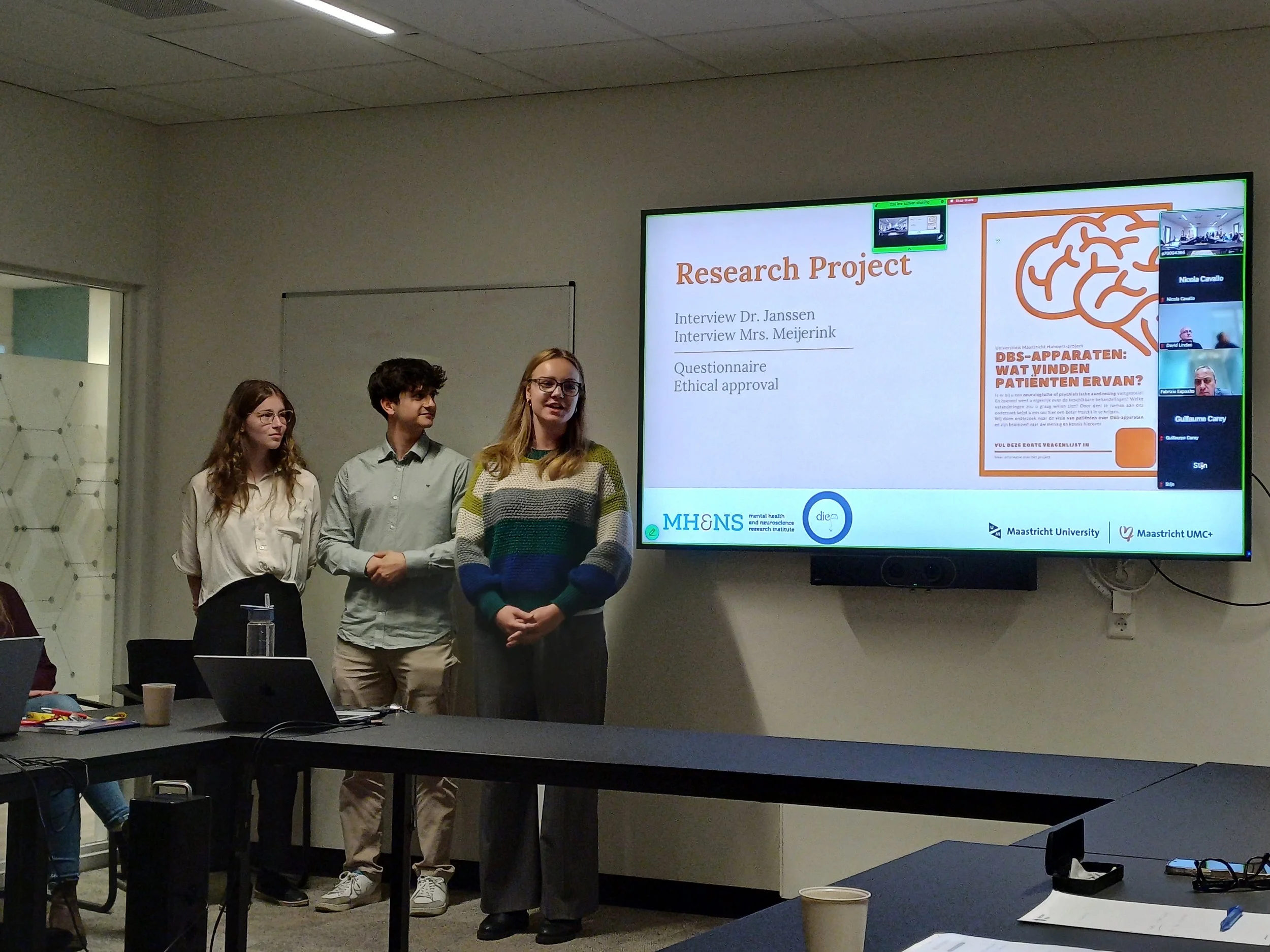
Neuripides 2024/25

April 24/25th
Maastricht University
Maastricht, Netherlands
We were lucky enough to be able to attend this year’s Neuripides conference in Maastricht, and listen to amazing presentations from both researchers presenting their recent projects, as well as patient representatives. Especially the patient representatives gave us very insightful points, new perspectives and considerations that helped us understand their position and concerns more.
The Highlights of the Conference
Monique from the Parkinson’s Association - The Patient Perspective
Before the actual conference started, we as students got a nice, spontaneous presentation from Monique, which was not actually scheduled for that day. Her presentation was about the image/stigma around Parkinson's disease. She explained that Parkinson's disease is mostly depicted as an old man who cannot move properly due to tremors. She stated that this is most of the time not the case. People only see the top of the iceberg of the symptoms of Parkinson's and not the “unseen” symptoms. Furthermore, she stated that Parkinson's patients are sensitive to the placebo effect. We can improve the lives of people with Parkinson’s if we can unlock the full potential of their minds
Sophia Gimple - Decision-making
An interesting presentation about decision-making was given by Sophia Gimple, who was at that moment a PhD student under the supervision of Christian Herff, Mark Janssen, and Yasin Temel. She let patients spin a wheel with different “prices,” and next the patients had to rate (from -5 to 5) how satisfied they were with their reward. She found a correlation between apathy and impulsivity. Impulsivity showed a strong relation with the maximum rating and with the number of times the button for “spinning the wheel” was pressed.
Keynote speaker Melvyn Roerdink - Augmented-Reality Treatment for
People with Parkinson’s Disease
Melyn Roerdink gave a very interesting presentation on the use of augmented reality in the treatment of Parkinson’s patients. One of the patients who tested and benefited from these augmented reality treatments was present at the conference. He demonstrated how cues (projected digital objects) can enhance therapy for Parkinson’s patients by helping them move more effectively and reducing freezing episodes. He went on to develop these cues into interactive games that patients can play. This innovative approach to Parkinson’s treatment offers an inspiring new perspective.
Meagan Hannemann - A Longitudinal Ultra-high field Imaging Study in Parkinson’s Disease
This was a PhD presentation on the early identification of MRI changes in Parkinson’s patients, conducted under the supervision of Mark Kuijf and David Linden. The purpose of the study was to correlate MRI characteristics with clinical phenotypes and the progression of symptoms. It was a longitudinal observational study with assessments conducted at baseline, after 2 years, and again after 4 years. It was interesting to see how a PhD pitch is presented and to learn more about the mechanisms behind such a longitudinal study.
Ricardo Loução - Cologne’s Status Quo
This was a presentation given by Ricardo Loução about neurofeedback and how this could improve the use of DBS for Parkinson Disease. Neurofeedback could give researchers information about the neural circuits that are involved in Parkison disease. They project analysed brain images of Parkison patients. Their finding was that more modulation of these neural circuits cause better outcomes for the patients.
Alessandro Bongioanni - Dynamic Connectivity States during Resting State fMRI for Neurofeedback
Dynamic connectivity states during resting state fMRI for neurofeedback: This presentation explores how dynamic functional connectivity states during resting-state fMRI can be leveraged for neurofeedback in Parkinson’s disease. It examines how deep brain stimulation (DBS) broadly modulates cortical activity and how neurofeedback targets may be defined at different levels, from single brain regions to whole-brain connectivity and clinical symptoms. Data from three major sources are analyzed: the PPMI cohort of sporadic and genetic PD patients with controls, the Prague dataset of DBS patients scanned with stimulation ON and OFF, and the Toronto dataset with alternating DBS ON/OFF conditions. Results compare static and dynamic connectivity patterns across these datasets, highlighting multiple brain states and their modulation by DBS. The ongoing work also investigates correlations with genetic factors and aims to establish cross-dataset benchmarks for neurofeedback and treatment strategies.
Guillaume Carey - Advanced Structural MRI of Parkinson’s Disease related Anxiety at 7T
This presentation investigates advanced structural MRI methods at 7T to study anxiety in Parkinson’s disease beyond traditional volumetric measures. Standard volume analyses often miss early and subtle changes, so multimodal approaches are applied, including assessments of iron deposition, shape, neuromelanin signal, texture, and tractometry. The work highlights alterations in thalamic and midbrain nuclei linked to PD-related anxiety, suggesting that reduced thalamic volume and other microstructural changes contribute to symptoms. Data from the TRACK-PD study are used to examine early PD (<3 years from diagnosis), where these advanced metrics reveal abnormalities invisible to conventional volumetry. The conclusion emphasizes the value of integrative imaging approaches and longitudinal data to develop more reliable biomarkers for anxiety and broader non-motor symptoms in Parkinson’s disease.
Halim Ibrahim Baqapuri - A Randomized Controlled Trial of fMRI-based Neurofeedback for Motor Symptoms of Parkinson’s Disease
Halim Ibrahim Baqapuri presented the MOTOR-NF trial, which tests fMRI-based neurofeedback for improving motor symptoms in Parkinson’s patients. The study uses individual MRI brain mapping to let patients practice controlling motor regions like the putamen and supplementary motor area. Early results showed significant activation changes in these areas, and people who used “high-energy motion” strategies had the best neurofeedback outcomes. Patients shared that practicing at home felt very different from inside the scanner, and staying awake during sessions was sometimes a challenge. Recruitment is ongoing, with promising early results and the study under editorial review.
Keynote speaker Mark Janssen - Lessons learned from Intra-operative
Micro-electrode Recordings
Mark Janssen’s talk discussed how intra-operative micro-electrode recordings (MER) during DBS at Maastricht UMC help improve targeting and clinical outcomes for Parkinson’s patients. He shared a patient example where left and right STN signals differed, impacting therapy adjustments. MER data—like peak frequency and response thresholds—are now used with closed-loop DBS devices to fine-tune stimulation in real time, even as patient age or disease severity changes signal properties. The technique is safe, adds patient-specific insight, and continues to guide new technology for better treatment.
Keynote speaker Robert Jech - Neuroimaging of DBS
Robert Jech presented about fMRI connectomics in Parkinson’s disease at the conference in Maastricht. He explained how advanced brain imaging shows how DBS (deep brain stimulation) changes large-scale brain network connectivity for patients. Highlights included new methods for mapping functional connections—like eigenvector centrality and seed-based analyses—which link network changes to clinical motor outcomes. His work found that increased connectivity in key motor and frontal regions correlated with better movement scores and DBS helped normalize activity patterns to resemble healthy controls. These techniques help guide future treatments and improve DBS programming for each patient.
Simone Nicola - Brain Connectomics Approach and Parkinson disease
The presentation outlined how brain connectomics and Network Control Theory can shed new light on the neural mechanisms underlying Parkinson’s disease (PD) and its treatments. Using data from Deep Brain Stimulation (DBS)patients and the 7-Tesla TRACK-PD study, it illustrated detailed preprocessing and analysis workflows for structural and functional MRI. Preliminary findings showed that DBS induces measurable changes in network connectivity, suggesting targeted modulation of brain circuits. The TRACK-PD results combined imaging and cognitive data, highlighting altered connectivity patterns associated with cognitive performance in PD. Looking ahead, the work aims to expand these analyses across larger datasets, explore regional coupling—especially in the thalamus—and apply machine learning to identify cognitive and network-based phenotypes that could guide more personalized treatment strategies.
Project Updates
Questionnaire
The top of the month brought on perhaps the biggest milestone in our project thus far. Following ethical approval and the final tweaks, our questionnaire has gone live! The items explore patient perspectives on DBS technologies, with a particular focus on Closed-Loop DBS acceptance.
We are working with colleagues from the MUMC+, as well as the Dutch Parkinson's Association, on our mission to explore underrepresented voices and insights. We are always looking to expand our collaborator network, from within the Netherlands, as well as the global medical stage.
The questionnaire may be completed at: https://maastrichtuniversity.eu.qualtrics.com/jfe/form/SV_cUXOa6ZC9cvTtl4.
EuroDBS conference
Our research group has been extended an invitation to present our project and preliminary findings at the December 2025 EuroDBS conference taking place in Freiburg. We are delighted to have been offered this opportunity and are currently undergoing the necessary preparation, hoping to deliver an insightful contribution. Look out for our November and December editions for further details.
DIEPcast Season 1
Over the month of October, our website and LinkedIn page have hosted 4 podcast episodes exploring DBS from various different angles – physicians, researchers, patients and advocates alike were invited to share their thoughts. Their contributions have helped paint a complex, multi-faceted image of the topic at hand and we are thrilled to have facilitated such fruitful discourse. By this way, we express our gratitude towards our guests, as well as our listeners. If you haven’t yet, make sure to check the episodes out!
Updates in the world of DBS
Medtronic BrainSense
October 2025 – TIME awards BrainSense™ Adaptive Deep Brain Stimulation (aDBS) the “Best Invention” title. Medtronic has been pioneering DBS technology for over 30 years, impacting the lives of millions of people living with Parkinson and beyond. Recently, they took yet another leap, enhancing the Percept™ neurostimulators with BrainSense™ technology, further personalizing therapy based on individual patient needs and neural activity. This novel technology detects, captures and classifies different brain signals, adapting device output in real time. This “marks a new era in neuromodulation and the use of therapeutic brain-computer interface technology to restore human health. ” [1]
Taking a closer look, BrainSense™ technology is made up of of five key features: “LFP survey, signal test, streaming, timeline and event recording”. This facilitates DBS programming by “supporting contact selection, assessment of clinical response to stimulation, stimulation optimization and symptom characterization in PD”. [2] On the one hand, BrainSense™ proves advantageous when considering device maintenance - rechargeable, reduced need for battery replacements - as well as the personalized, adjustable and reversible nature of aDBS, supplemented by the real-time feature. On the other hand, “motor symptoms, medication state, movement and location of the DBS” may affect LFP signals, MRI compatibility is not yet optimal and further technological shortcomings must be taken into account.
All in all, Medtronic’s BrainSense™ technology represents a substantial leap forward on the neuromodulation technology scene, supplementing the already impactful progress which the company has made in closed-loop DBS applications. Future papers may explore multi-perspective considerations on this new technology and its application, for Parkinson Disease and beyond.
Ethics in Closed Loop Neurotechnology
Monitoring these medical technological advancements closely are those concerned with their ethical ramifications; closed Loop DBS is no exception. As (psychiatric) neurosurgery moves towards personalized, wearable and integrated technologies, a pandora’s box of ethical dilemmas - informed consent, autonomy and accountability, to name a few - blows open. A special issue of “Brain Sciences-Neuropsychiatry” ponders: “To what extent is it acceptable to intervene in brain circuitry to modulate emotional states? Can patients with impaired autonomy truly give valid informed consent?” [3] . Thus, issues of informed consent, decisional capacity, and, by extension, bodily autonomy, arise not only when speaking of aDBS, but when looking at psychiatric neurosurgery as a whole. While ethical committees have been tasked with tackling these issues, further gaps prevail. Elements such as reliance on artificial intelligence, data privacy gray areas and equitable access [4] are seldom addressed outside of literature, namely in actual clinical practice.
Through our contribution, we hope to represent the cornerstone to a much needed bridge between patients and physicians, aiding the inclusion of oftentimes underheard voices in decisions which impact their lives firsthand. By the means of our questionnaire, we hope to gain a better understanding of what actually matters to them, creating the spark that will light the fuse of change.
Mount Sinai: DBS for depression
Exciting news out of New York – a team from the Icahn School of Medicine at Mount Sinai, first in the country to implant DBS for depression study. As part of the TRANSCEND clinical trial investigating Abbot’s™ systems for treatment-resistant depression, Prof. Dr. Kopell’s group performed this ground-breaking surgery. Currently, 24 other sites in the US are set out to follow in their footsteps. [5]
The stimulation occurs in the subcallosal cingulate cortex, a target which was identified thanks to Prof. Dr. Mayberg – pioneer in “[…] her study of brain circuits and deep brain stimulation research over the past 20 years”. She identified the subcallosal cingulate as a “signalling hub for depression” and postulated that signal modulation may alleviate symptoms, which was subsequently confirmed by years of “independent, single-arm, open-label, grant-funded studies”.
In a recent lecture at Brown University, Prof. Dr. Mayberg shared further insights on the subject [6]. She spoke on the early days of her career, when she identified area 25 – the subcallosal cingulate cortex – as a mediator of emotional and memory functions. Over the next years, following the implementation of DBS for Parkinson, she helped adapt the technology for treatment-resistant depression, aided by her previous findings. Her 2005 paper [7] already showed significant promise in terms of symptom improvement, and now, 20 years later, they are ready to do it again, even better. We are looking forward to hearing more about the new clinical trial in the years to come!
1- Medtronic BrainSenseTM Adaptive Deep Brain Stimulation named a 2025 TIME Best Inventions [Internet]. Medtronic News. 2025 [cited 2025 Nov 5]. Available from: https://news.medtronic.com/2025-10-09-Medtronic-BrainSense-TM-Adaptive-Deep-Brain-Stimulation-named-a-2025-TIME-Best-Inventions
2- Saengphatrachai W, Jimenez-Shahed J. Current and future applications of local field potential-guided programming for Parkinson’s disease with the PerceptTM rechargeable neurostimulator. Neurodegenerative Disease Management [Internet]. 2024 Sep 2 [cited 2025 Mar 26];14(5):131–47. Available from: https://pmc.ncbi.nlm.nih.gov/articles/PMC11524207/
3- Torres CV, García MN, Rivas PP, Mónica Lara Almunia, Fernández A. Shaping the Future of Psychiatric Neurosurgery: From Connectomic Precision to Technological Integration. Brain Sciences [Internet]. 2025 Jun 16 [cited 2025 Jul 23];15(6):647–7. Available from: https://pmc.ncbi.nlm.nih.gov/articles/PMC12190430/
4- Haag L, Starke G, Ploner M, Ienca M. Ethical gaps in closed-loop neurotechnology: a scoping review. npj Digital Medicine. 2025 Aug 8;8(1).
5- Kim J. Mount Sinai professor discusses emerging potential of deep brain stimulation for depression treatment [Internet]. The Brown Daily Herald. 2025 [cited 2025 Nov 5]. Available from: https://www.browndailyherald.com/article/2025/11/mount-sinai-professor-discusses-emerging-potential-of-deep-brain-stimulation-for-depression-treatment
6- Mount. Mount Sinai Is First in the Nation to Perform Deep Brain Stimulation Implant as Part of Clinical Trial for Depression [Internet]. Mount Sinai Health System. 2025. Available from: https://www.mountsinai.org/about/newsroom/2025/mount-sinai-is-first-in-the-nation-to-perform-deep-brain-stimulation-implant-as-part-of-clinical-trial-for-depression
7- Mayberg HS, Lozano AM, Voon V, McNeely HE, Seminowicz D, Hamani C, et al. Deep Brain Stimulation for Treatment-Resistant Depression. Neuron [Internet]. 2005 Mar;45(5):651–60. Available from: https://www.sciencedirect.com/science/article/pii/S089662730500156X